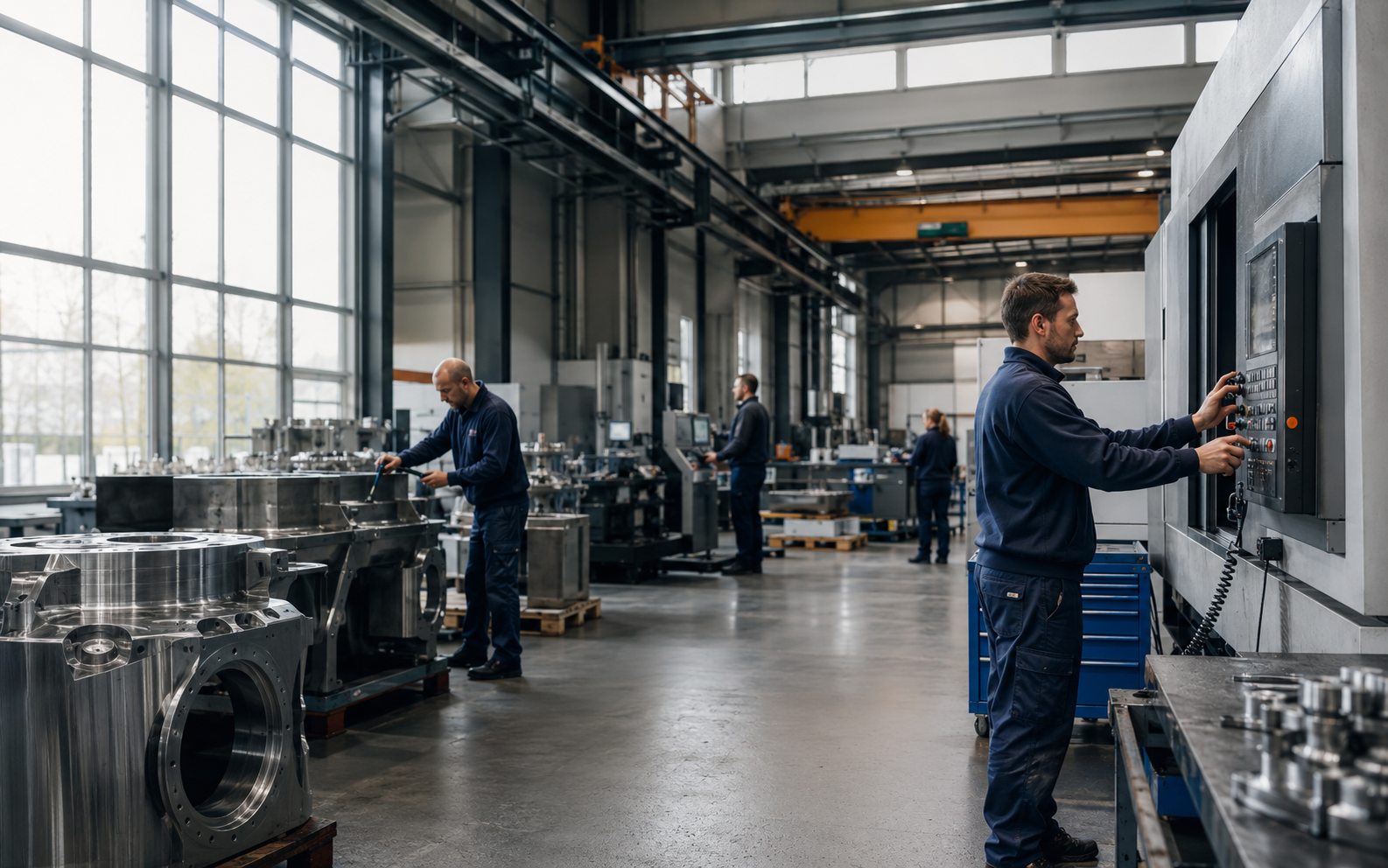
Technicians working beside machinery in an industrial production hall

Understanding the Mittelstand

What is the German Mittelstand?

The Mittelstand is more than Germany’s small and medium-sized business sector. It is an ownership culture built on specialisation, continuity, vocational skills and responsibility for place.

Explore the full perspective ↓
The culture behind the capability
3.5M+ Mittelstand companies
99% of German companies
60% of employees
80% of apprentices
01

A model built over generations

The Mittelstand succeeds because strategy, ownership and responsibility sit close together.

A specialist machine builder in a small town may supply five continents, train young people locally and reinvest most earnings into its next generation of products. This blend of global ambition and regional commitment is the real story behind the statistics.

Three lenses

01

Ownership

Leadership, reputation and economic risk remain closely connected.

02

Capability

Deep expertise is accumulated through people, processes and customer intimacy.

03

Continuity

Patient investment and vocational training preserve knowledge across generations.

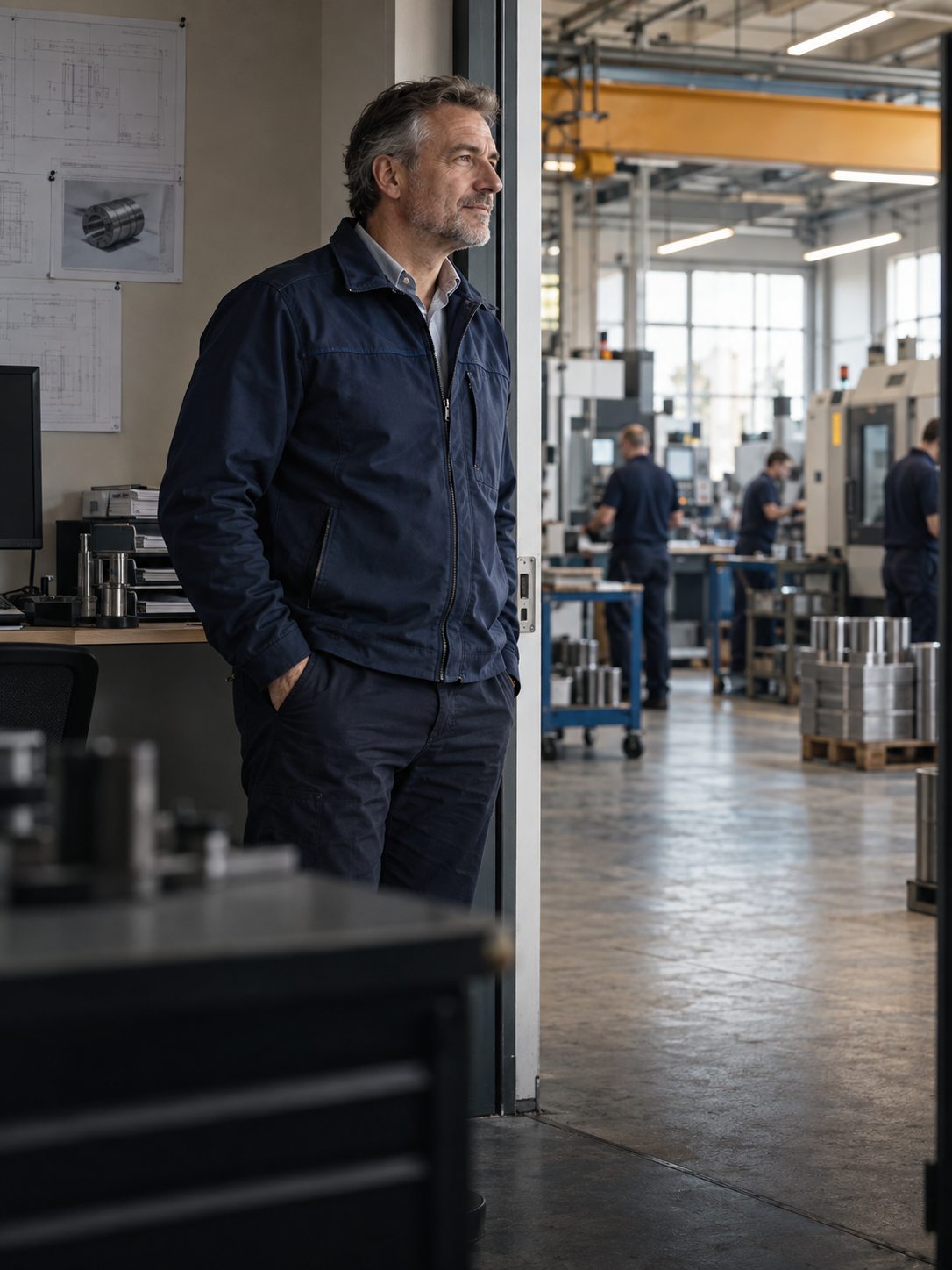
Owner-manager standing between a factory office and a production workshop 01 German Mittelstand
Chapter 01

A business culture, not merely a size class

Official statistics typically classify SMEs by employment and revenue. The German idea of Mittelstand goes further. It describes companies in which ownership, leadership and commercial responsibility remain closely connected. Many are family controlled, locally rooted and privately financed. This gives management the freedom to invest with a longer horizon.

The distinction matters when reading business statistics or evaluating a potential partner. A size-based SME category describes employment and financial scale; Mittelstand describes the relationship between owners and management. These categories overlap, but they answer different questions. Before comparing two reports, check whether their populations cover SMEs, family businesses or owner-managed companies. A large owner-managed manufacturer and a small subsidiary may fall on different sides of these definitions.

Engineer inspecting a small precision component under a magnifying task lamp 02 Mittelstand definition
Chapter 02

Why specialisation matters

Mittelstand companies rarely try to serve every market. They build deep expertise in a narrow field: a component, process, machine, material or service that customers cannot easily replace.

Specialisation becomes commercially valuable when a supplier understands the customer’s process in detail. A component may be a small part of the final machine yet determine its reliability, maintenance interval or production speed. For buyers, the useful evidence is application knowledge, documented quality and service capability. For suppliers, the strategic challenge is to deepen that expertise without becoming dependent on a single customer or an ageing product line.

  • High engineering depth and close customer relationships
  • Export strength based on niche leadership
  • Continuous improvement rather than short product cycles
Two generations reviewing engineering drawings at a timber meeting table 03 German SMEs
Chapter 03

Family ownership and patient capital

Many firms measure success across generations. Succession, reputation and employee stability influence decisions alongside profit. That does not make every company conservative; it can enable bold investment because owners are not governed only by quarterly market expectations.

Ownership continuity can support decisions whose benefits arrive over several investment cycles. It also makes governance important: a company needs clear responsibilities when family members, external executives and the next generation work together. A practical review should distinguish family expectations from operating roles, identify who approves investment and document how disagreements are resolved. Long-term thinking works best when it is supported by transparent information and a credible leadership transition.

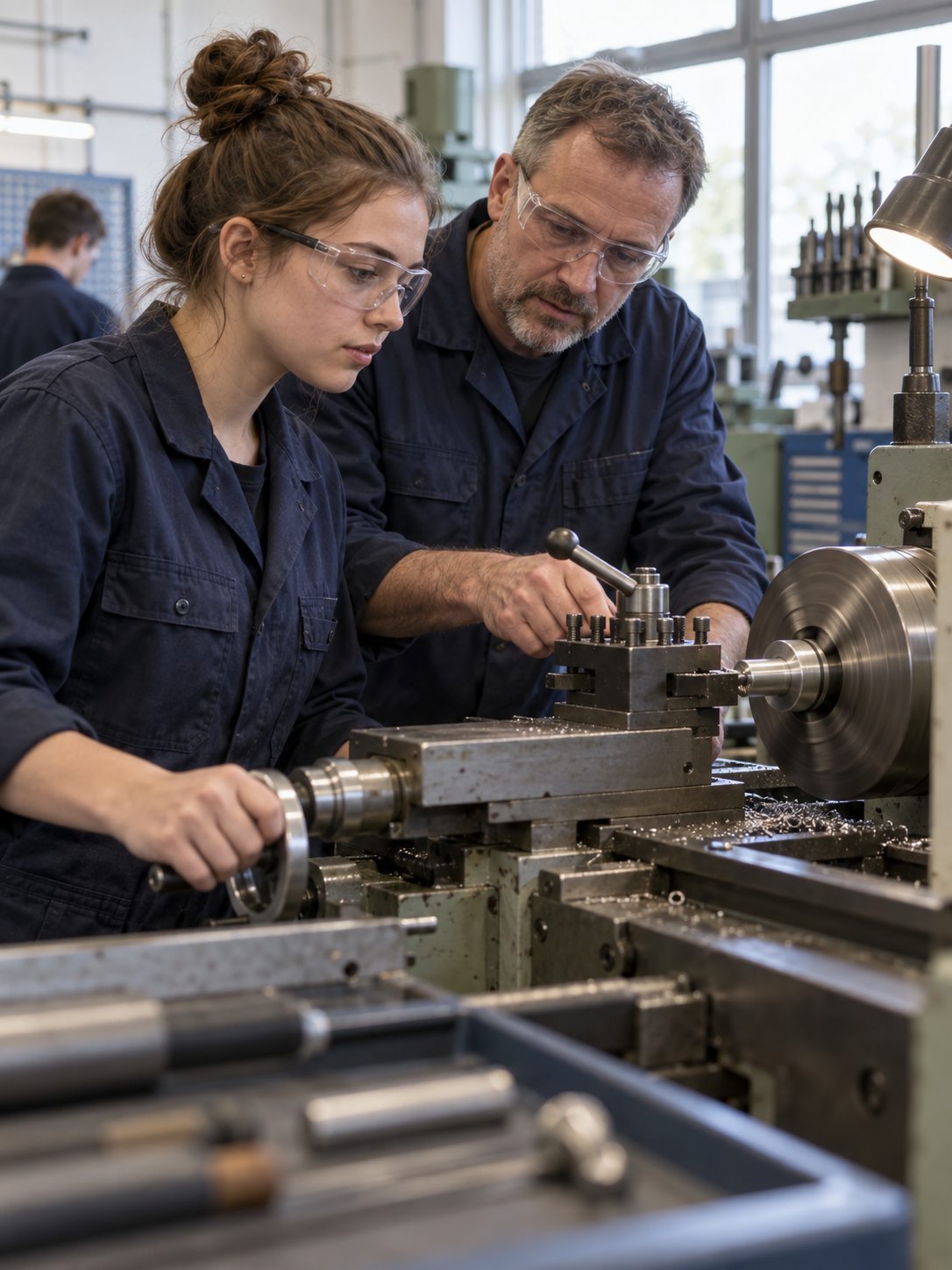
Apprentice learning to operate a lathe with an experienced instructor 04 family businesses Germany
Chapter 04

The dual vocational system

Apprenticeships connect classroom learning with practical work inside companies. The system helps firms develop role-specific skills and transfers tacit knowledge from experienced workers to the next generation.

Training is most valuable when learning is connected to actual work. Employers can make tacit knowledge easier to transfer through supervised practice, process documentation and structured feedback. For international partners, this means understanding who owns technical decisions and who trains new colleagues. For prospective employees, useful questions include the availability of mentoring, opportunities to learn across departments and how the company develops specialists into team leaders.

The Mittelstand reference

A business model shaped over generations.

Germany’s Mittelstand is best understood through the relationship between specialised skills, ownership and local institutions. Its story sits within a wider economic history rather than a single founding moment.

Reconstruction and the economic miracle

West Germany’s rapid post-war recovery, especially in the 1950s, combined reconstruction with changing economic institutions. The Federal Agency for Civic Education explains the roles of currency reform, the Marshall Plan and the social market economy.

Official resource

Skills reproduced through work

Company-based learning and vocational schooling create a continuing link between education and production. BIBB explains how the two learning environments work together in the dual system.

Official resource

Continuity through ownership

The connection between ownership and management helps distinguish Mittelstand from a purely size-based business category. That distinction remains useful when looking at the model’s future.

Official resource

The Mittelstand reference

Ausbildung and dual study: different routes to capability.

Workplace learning is central to the Mittelstand talent pipeline, but different educational routes lead to different qualifications. Employers and candidates should check the specific programme rather than assuming every route combines the same credentials.

RouteLearning modelWhat to verify
Dual vocational training / AusbildungCompany-based training alongside vocational school.Occupation, training contract and examination arrangements.
Duales StudiumAcademic study combined with structured company experience.Whether the course is practice-integrated or also includes a recognised vocational qualification.
School-based vocational educationLearning centred on a vocational school, with practical elements depending on the occupation.Qualification, practical placements and the requirements of the individual course.

BIBB: the dual system · Find dual degree programmes with AusbildungPlus · DAAD: choosing a degree programme

Compare your options

Mittelstand, SME and hidden champion: what changes?

Mittelstand, SME and hidden champion: what changes?
TermWhat it describesHow to use it
MittelstandThe connection between ownership and managementUnderstand governance and decision-making
SME / KMUBusiness size under a specified definitionCheck statistics or programme eligibility
Hidden championA specialist with a strong position in a nicheInvestigate product expertise and market evidence

Put the guide to work

How to assess a Mittelstand business partner

A practical framework from Mittelstand United. Adapt these steps to your business, operating context and available evidence.

  1. 01

    Start with the application

    Describe the technical problem, operating environment and expected service life. A precise brief helps a specialist show where its capabilities fit.

  2. 02

    Meet the people behind delivery

    Ask who makes engineering decisions, who manages quality and who will remain accountable after the sale. Record the escalation path before starting a pilot.

  3. 03

    Validate before scaling

    Use a sample order or bounded project to test communication, documentation and delivery. Evaluate total lifecycle support alongside the initial price.

Go to the source

Continue with the official sources.

IfM Bonn distinguishes Mittelstand through the connection between ownership and management. Read the source Germany Trade & Invest describes industry strengths and regional business clusters. Read the source

IfM Bonn: ownership and management definition Germany Trade & Invest: industries and clusters
Source links checked 9 September 2026. Chapter images are AI-generated illustrations and do not identify a featured company or location.

Frequently asked questions

Clear answers,
useful context.

Is every German SME a Mittelstand company?+

Not necessarily. SME is a statistical category; Mittelstand can also describe ownership, leadership and long-term culture.

What is a hidden champion?+

A relatively little-known company that holds a leading position in a specialised global or European market.

Why is the Mittelstand important to Germany?+

It distributes employment, skills, innovation and investment across large cities and smaller regions.

Does Mittelstand mean only manufacturing?+

No. The term also applies to owner-managed businesses in services, trade and other sectors. Manufacturing is prominent in the international image of the Mittelstand, but it is not its complete definition.
Your next conversation

Bring your next question.

Discuss your business context, explore the connected guides or start a conversation with Mittelstand United.

Connect with Mittelstand United ↗

Continue exploring

Transformation agenda The biggest challenges facing German SMEs ↗ Germany’s support ecosystem Support and funding for German SMEs ↗ 16 states · many clusters Germany’s regional Mittelstand landscape ↗